





A Complete Healthcare App Development Process for Startups and Healthcare Businesses
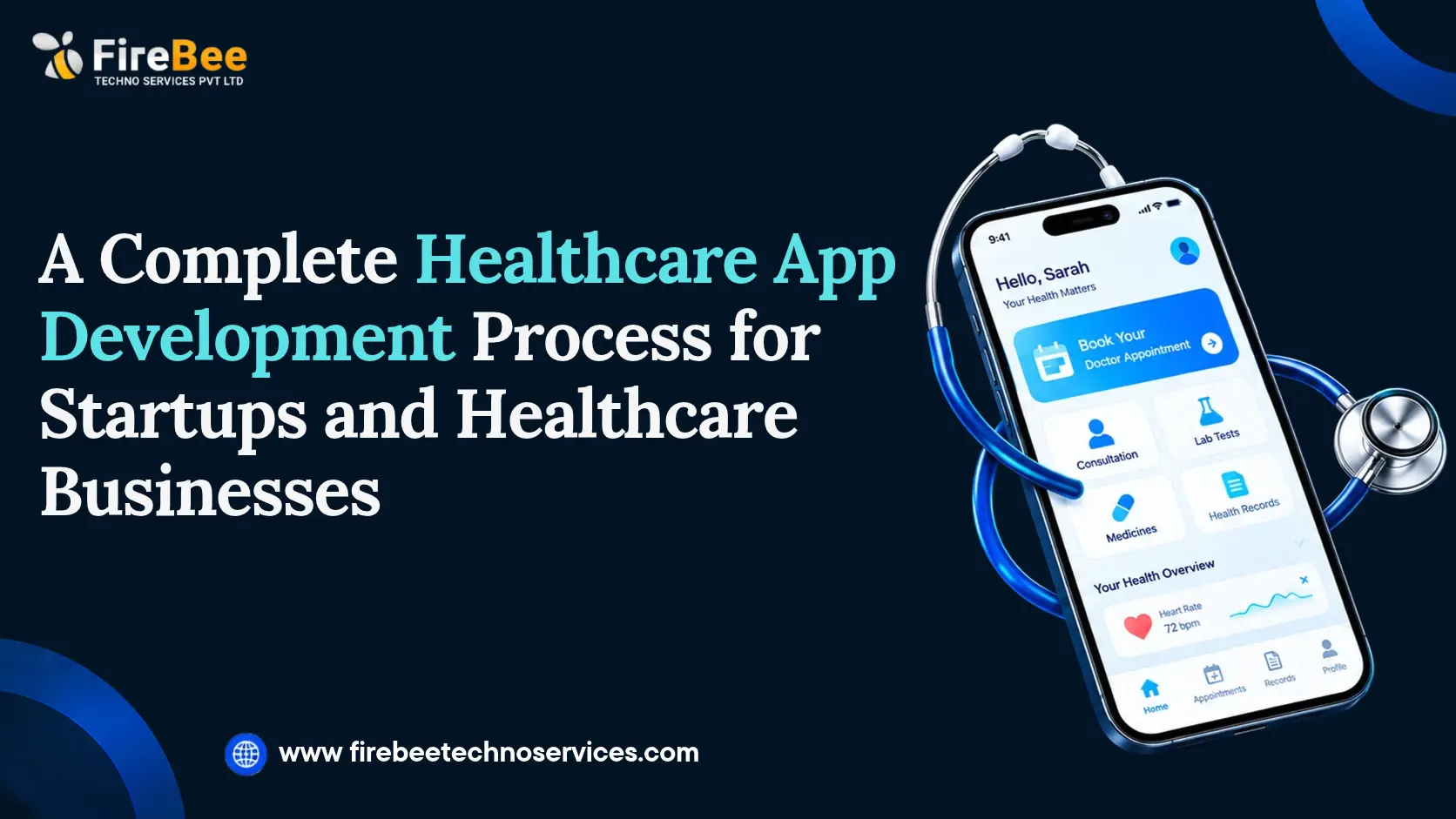
Healthcare companies are embracing mobile technologies to enhance patients’ experience, provide physicians with their services, and organize health-related data. Such apps allow patients to arrange doctor’s appointments, consult via video calls, track their health conditions from anywhere, store personal data, and do many other things.
However, healthcare app development requires specific attention to the range of factors, enabling services for patients, medical professionals, and businesses, as well as devices that monitor and store health data and information. Thus, although such software may seem easy to use and beneficial for all parties involved, it involves a number of issues that have to be taken into account.
What Is Healthcare App Development and How Does It Work?
Healthcare App Development can be defined as the application that facilitates interaction, communication, exchange of information and transaction of services by means of a software application for healthcare related purposes. It generally involves the provision of services to users while assuring privacy of sensitive information.
The general on demand app development workflow begins with end user interaction with the application through a mobile interface. From there, the application or API layer queries, stores, or updates healthcare data while applying identity and access management rules and linking to external systems or devices before providing relevant information to official users.
Types of Healthcare Apps Businesses Can Develop
Healthcare businesses can choose from a variety of Healthcare App Development options based on their target audience, the services they provide, operational needs and the level of connection they want to have with patients.
1. Patient Facing Healthcare Apps
- Patient Portal App: This app handle appointments, medical records, prescriptions, lab results, billing and messaging
- Doctor Appointment App: Users can find doctors, book appointments, check availability, reschedule and cancel appointments
- Telemedicine App: Supports video consultations, online prescriptions, follow up consultation and online consultation records
- Pharmacy and Prescription App: This kind of app handles digital prescriptions, ordering medicine and refills
- Patient Engagement App: Helps remind patients, provide care instructions and communicate via healthcare mobile app development services
2. Provider Facing Healthcare Apps
- Doctor App: Created to view patient information, manage appointments, notes, prescriptions and follow up
- Nurse App: provide managing patient appointments, patient vitals, medication, nursing instructions and tasks
- Clinical Documentation App: It gives digital clinical notes, patient history, diagnosis and treatment documentation
- Medical Reference App: Provides drug information, medical references and medical calculators
- Doctor Communication App: Enables secure doctor to doctor, doctor to specialist, doctor to nurse and care team communication
3. Hospital & Administrative Healthcare Apps
- Hospital Management App: Handles patient registration, appointments, departments, staff, beds and hospital management
- Hospital Billing App: This provide treatment billing, invoices, insurance information, payments and billing records
- Hospital Staff Management App: This type of apps manage staff scheduling, shifts, attendance and staff management
- Medical Inventory Management App: Covers medicines, tools, stock listing, purchase and management stock.
- Insurance and Policies Management App: It supports insurance claims, prior authorizations, verifications and policy management
4. Remote Care & Connected Health Apps
- Remote Patient Monitoring App: Vital tracking, automated patient monitoring and related data transfer are all included in the category of remote patient monitoring applications.
- Home Healthcare App: It organizes home healthcare visits, nursing services, patient appointments and care
- Connected Medical Device App: Connects medical devices authorized by the hospital and sends patient data
- Chronic Illness Tracking App: This application can track chronic diseases like diabetes, hypertension and cardiac care
- Wearable Health Monitoring App: Handles health and activity tracking using authorized wearable devices
Why Are Businesses Investing in Healthcare Mobile App Development?
The importance of digital workflows in healthcare arises when there are automated manual procedures, service delivery systems and operations information simplification. Healthcare Mobile App Development helps to create such workflows based on real needs for services.
Improve Patient Access to Healthcare Services
Without any guidance, patients can do registration, appointment requests, medicine refills, form submissions, payments and record access. These patient routines can be the basis for functions created by a healthcare app development company.
Simplify Clinical Procedures
Processes for clinical documentation, assigning patients, managing prescriptions, follow-ups, and task completion can be specified in workflows. The processes can then be implemented in an application by a healthcare app developer.
Connect Disconnected Healthcare Systems and Workflows
Healthcare mobile app development can make work together selected EHR, EMR, lab, pharmacy, billing and devices through APIs and healthcare data where integration is needed.
Extend Care Beyond Hospital Visits
Digital consultations, home healthcare, remote monitoring, prescription services, and on demand app development can help organizations deliver selected services without requiring every interaction to occur inside a healthcare facility.
Support Data Based Healthcare Operations
Organized application data enables management of appointment rates, service activity, billing records, supplies distribution, employee workloads, and other operational data collected through regular usage of that application.
Core Technical Architecture Behind a Scalable Healthcare App
Architecture of Health Care App Development has to be in accordance with the users, clinical information needs, interoperability requirements, security mechanisms, communication requirements and operational load.
- App Experience
React Native and Flutter React and Angular provide mobile and web applications for medical related people like patients, clinicians and care methods.
- Healthcare Compatibility
FHIR and HL7 are responsible for proper healthcare data exchange while the APIs provide connections between healthcare systems.
- EHR/EMR Integration
Integration services and APIs are meant to connect applications with the EMR and EHR systems in order to send relevant medical and patient information.
- Healthcare Data Layer
PostgreSQL, MySQL, and MongoDB store structured and flexible healthcare application data based on system requirements.
- Identity, Consent & Access
OAuth 2.0, OpenID Connect, role based access control and consent management allow controlling the authentication process, rights and access to the some authorized data in healthcare.
- Audit Logging & Data Exchange
Audit logging allows capturing necessary events on the system and users, whereas healthcare data exchange services ensure data circulation.
- Medical Device Connectivity
Bluetooth technology and the relevant APIs make it possible to connect the relevant medical instruments with other devices and to share selected data.
- Communication in Real Time
WebSockets, WebRTC and Firebase are the technologies that help to provide the important parts of the application like messaging, communication, notifications and live updates.
Process of Healthcare App Development Process
A structured Healthcare App Development procedure helps teams define the right scope before development starts and includes functionality, access, testing, deployment and post launch support.
Step 1: Define Healthcare Requirements and Users
Before preparing for mobile app development, healthcare issues, target audience, workflows needed, customer information to be covered, user permissions, integrations and key functionalities need to be determined.
Step 2: Plan the App Architecture and Integrations
It is important to map the application components, movement of data as well as external systems and APIs needed by the applications, roles of users, connections of different devices etc. to establish the technical structure of the application.
Step 3: Design the User Experience
User flows and interfaces must be made according to the real-life work of the healthcare specialists where the mobile application developer responsible for designing navigation for patients, doctors, managers, and other users must be involved.
Step 4: Develop the Application
A healthcare app development company needs to transform the approved designs and technical papers into the following functions of the app: APIs, data processing methods, integrations, and user functions.
Step 5: Implement Security and Access Controls
Healthcare information has to be protected with the help of proper methods such as authentication and authorization, encryption, and consent control, and compliance with existing healthcare regulations concerned with the area of health care.
Step 6: Test Clinical and Operational Scenarios
Role permissions, healthcare flows, data validation, API response testing, appointment states, prescription management, device inputs, error handling and recovery will be tested under defined scenarios.
Step 7: Launch and Track the Application
Release the app through Mobile App Development. Track system activity and integration health. Debug production issues. Implement updates and maintain connected services as needs change.
Future Trends Influencing Healthcare App Development
AI healthcare applications are becoming increasingly interconnected as interoperability tools, connected devices, virtual care, and other forms of digital health solutions become an integrated part of healthcare technology environments.
AI Assisted Healthcare Workflows
Healthcare App Development steps into the next chapter that includes AI, where mistakes can happen, such as in clinical documentation assistance, information extraction, patient query handling, summarization and decision support workflows
Use of Connected Medical Devices
Medical devices and wearables are becoming more connected to healthcare mobile app development services, creating requirements for device APIs, measurement validation, data transmission, and controlled handling of incoming health information.
Expansion of Virtual Care Infrastructure
Video consultations, digital prescriptions, scheduling, payment processing and remote follow up are driving demand for applications to link virtual care into the broader healthcare ecosystem.
Wider Adoption of Interoperable Data Exchange
Healthcare app development will be influenced by the need to adopt standards such as FHIR and HL7 to allow applications to exchange defined sets of healthcare information with electronic health records, laboratories, pharmacies, and other integrated systems.
Why Choose Fire Bee Techno Services as a Healthcare App Development Company?
Fire Bee Techno Services offers healthcare applications that include patient management, physician management, administration, remote care and integration procedures. Our healthcare app developers manage appointments, information exchange, communication, security, and healthcare application programming interfaces, medical devices, and other procedures.
We examine the user’s role, healthcare process, necessary data, integration needs, and technical design. Our experts assure that the process of Mobile App Development fulfills every function by constructing a detailed list of requirements and validating it against specific use cases. We manage the application development process, implement functions, evaluate and approve the application’s use cases, and launch the tool. After deployment, we will manage updates, integration changes and new features.


