


Everything You Need To Know About Real Estate Tokenization Development

Real estate tokenization started in 2018 when blockchain allowed property assets to be split into small digital parts that investors could buy. Global property token market value touched 4 billion dollars by 2024 and can grow beyond 16 billion by 2030.
Many businesses entered this field due to high returns and easier access. Token sales generate stable income and reduce paperwork. Investment flow increases from worldwide sources. This blog shares a complete idea about token-based property business growth in detail.
What is Real Estate Tokenization?
Real estate tokenization turns property value into blockchain-based tokens. These digital units represent small parts of physical buildings or land and allow people to buy or sell these parts without handling the entire property.
Ownership records stay on blockchain networks, which reduces paper use and increases transaction speed. Investors can hold tokens of large projects while spending less money. This process also removes many middle steps and improves property investment across regions.
Difference Between Real Estate Tokenization and Traditional Real Estate Investment
| Feature | Real Estate Tokenization | Traditional Real Estate Investment |
| Liquidity | High, allows fractional trading on blockchain | Low, selling takes time |
| Accessibility | Open to all | Less accessible |
| Transparency | Clear records via public ledger | Hard to verify records |
| Smart Contracts | Automated processes, fewer middlemen | Manual, involves many parties |
| Global Reach | Easy global access | Limited by location and rules |
| Management | Digital platforms simplify asset management | Requires physical oversight and effort |
| Entry & Exit | Fast entry and exit through digital platforms | Time-consuming buying and selling process |
RWA Tokenization Platform Working Methodology:
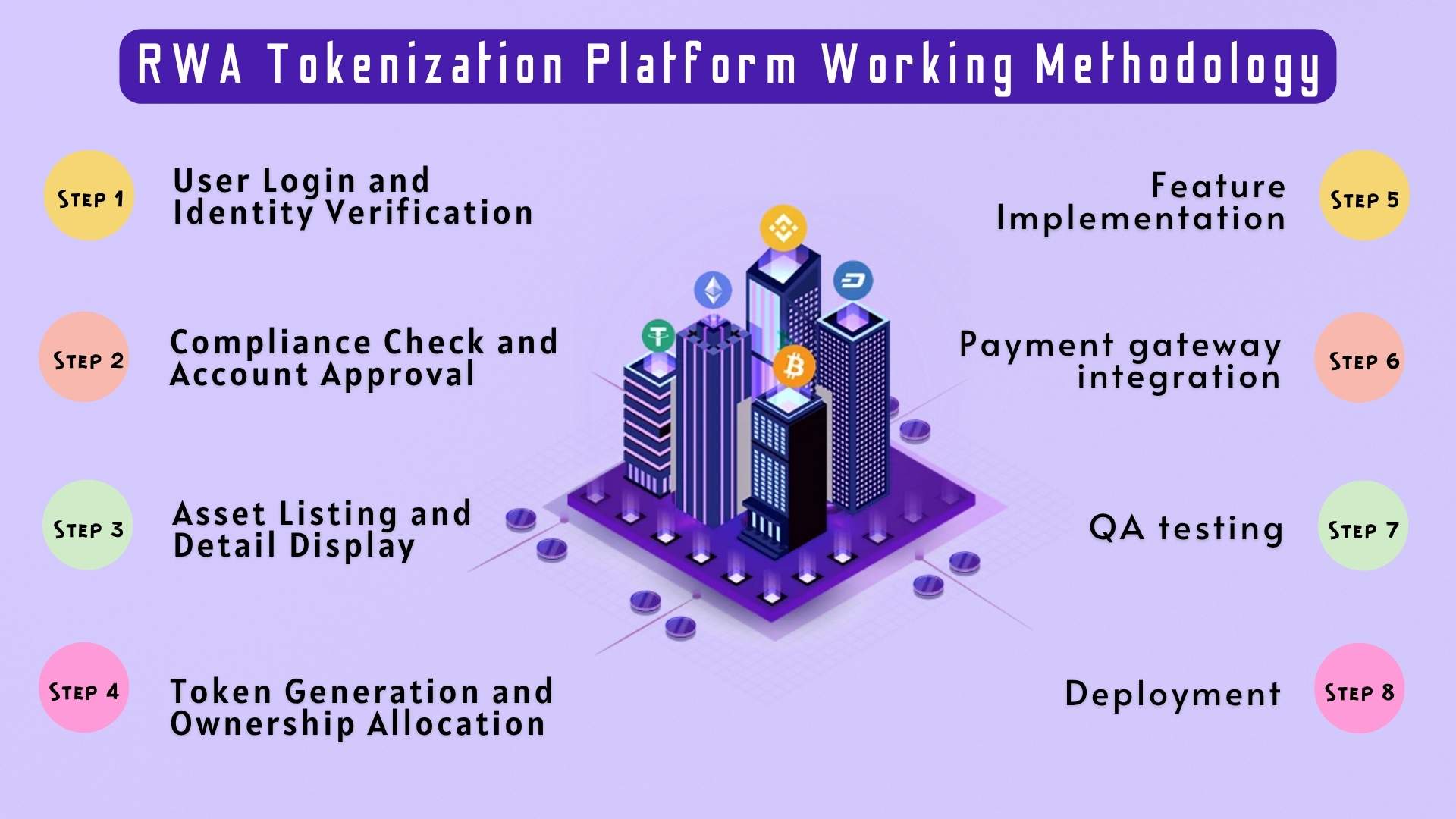
1. User Login and Identity Verification
User access begins with account registration, where identity documents go through verification steps because legal safety requires a proper KYC process before use.
2. Compliance Check and Account Approval
The platform reviews each profile based on legal rules and regional laws, where approval or rejection depends on document match and user eligibility for platform use.
3. Asset Listing and Detail Display
Available real-world assets show structured information with value range category holding terms and risk level, where users check the token supply before action.
4. Token Generation and Ownership Allocation
Smart contract creates tokens for selected assets, where each token shows a value share and gets assigned to investors based on purchase quantity, with digital tracking.
5. Wallet Update and Transaction Record
The investor wallet reflects the token count while the platform saves transaction details like hash value, time, and owner ID without losing any history or sequence.
6. Automated Contract Execution
Smart contract follows programmed rules for ownership, limits transfer, lock period, resale, and income share with no manual change or outside control.
7. Payment Flow and Withdrawal Handling
Fiat and crypto money move through connected payment channels where a deposit adds balance, and a withdrawal takes place after the platform confirms matching data.
8. Income Calculation and Payout Settlement
The platform completes the earning cycle with income shown inside the user panel and payment done as per holding share, along with a downloadable report and date proof.
Highly Demanded Real Estate Tokenization Development Services:
Residential Property Tokenization
Residential property ownership stays limited in traditional models due to high capital needs. Property owners receive structured help to tokenize their homes. Buyers receive access to smaller portions of homes without complete purchase burdens. Owners raise capital with ease while investors join property markets through minimal shares. Simple blockchain infrastructure helps record every activity involving ownership and transfer without delays.
Commercial Property Tokenization
Commercial asset ownership draws large investors, but tokenization reduces barriers. Owners of business centres or office parks convert properties into tokens. People gain entry to expensive markets through token share acquisition. Returns from such tokens arrive from rental incomes or value appreciation. All transactions receive real-time records on the blockchain, which avoids manual intervention. Secure platforms handle trade and asset transfers among holders.
Mixed-Use Property Tokenization
It has residential and commercial spaces. Tokenization for such spaces brings clear distinctions in ownership records for varied sections. Specialists manage the categorization of token portions based on actual utility or expected revenue. Investors may receive tokens for shops while also owning shares in apartments. Proper planning and legal design help create better trust for both developers and investors.
Retail Property Tokenization
Retail spaces inside malls or shopping complexes attract buyers through token models. Owners of shops and larger retail halls create digital shares for public or private sale. Revenue splits follow predefined smart contract terms, avoiding third-party confusion. Retail tokenization allows distributed ownership in zones that were once handled by only institutions.
Hospitality Property Tokenization
Hotels or resorts remain capital-heavy projects that see limited investor groups. With token features added to these assets, distribution spreads widely. Shareholders of hotel tokens receive dividends based on room income or event usage. Operators manage regular reporting through automated ledgers. Investors receive verified information with token movement handled by blockchain entries. Accessibility to high-value properties grows due to lowered share costs.
Industrial Property Tokenization
Industrial zones such as warehouses or logistics parks require huge investments. Token-based access helps divide such zones into smaller ownership rights. Investors with lower capital gain entry and enjoy fixed returns from storage rentals or facility usage. Each token maintains records of ownership, income allocation, and possible disputes without extra legal formalities. Cross-border participation also grows as investors receive real-time data.
Vacation Property Tokenization
Holiday homes or cottages bring seasonal income. Property owners digitize assets into token units to allow group-based ownership. Each token holder receives part ownership based on season use and contribution. Automatic rent splits occur without middle channels. Platforms keep schedules and payment logs updated for each token. Regional regulations also connect to the contracts through code-level compliance.
Luxury Property Tokenization
Luxury homes or high-end properties often face access limits. Tokenization enables selected access through a share sale while the original remains unaffected. People receive tokens for villas. Only certain investors take part based on capital needs and brand control. Contracts protect exclusivity and maintain property values. Even with shared ownership, the identity of property remains premium, with record maintenance controlled on secure platforms.
Successful Tokenized Real Estate Examples
Aspen Coin
Aspen Coin is based in Colorado. The St. Regis Aspen project turned ownership into blockchain tokens, which allowed investment without full purchase. Token sales helped raise funds while also offering investors ongoing benefits. The platform managed transfer processes smoothly. Legal protections applied under U.S. law ensured safe entry for token holders.
Slice
Slice introduced tokenized entry to luxury towers such as One World Trade Center in New York. Real estate previously accessed only by large funds has now opened for multiple shareholders. The token model divided ownership and created shared records using blockchain protocols. Revenue and rental proceeds followed fair digital processes. Transparency and reach improved due to online infrastructure.
Real Estate Asset Ledger (REAL)
REAL used blockchain to tokenize office buildings and business spaces. Ownership remained clear due to digital ledger transparency. Investors from different countries bought shares in commercial assets. Security of transactions improved due to reduced need for paperwork. Returns from income-generating assets are passed to token holders with automatic ledgers managing contracts.
Propy
Propy supported a full blockchain property transaction in Ukraine. A house was bought entirely through tokens. The method proved how smart contracts could replace traditional registration offices. The instant proof of trade is given. Title updates appeared on digital records without external notarisation. Efficiency and trust increased due to simple digital contracts.
Top 10 Benefits of Real Estate Tokenization
- Global Investment Access: Property access used to remain local and limited. Tokenized assets now help buyers take part in real estate across continents. Residential homes in Europe attract Asian buyers. Office towers in America receive support from African investors. Digital platforms remove location barriers. Transactions happen quickly without long-distance travel or legal risk. Ownership proofs remain secure through automated entries.
- Fractional Ownership: Property investment no longer needs a full amount. Investors select how much to invest through the token count. One may own a tiny share of an apartment or a larger piece of a mall. Diversification becomes easy due to token-based rights. Each investor can balance risk and reward through token spread.
- Instant Liquidity: Traditional property sale involves delays and paperwork. Tokenized property can be traded like a share. Platforms support token exchange where holders buy or sell units. Secondary buyers join without issue. Funds move faster due to instant ownership updates. Sellers gain quicker returns while buyers join without long waits.
- Reduce Transaction Costs: Bankers, lawyers, and brokers usually take part in real estate trade. With tokenization, they stay away. Smart contracts carry out rent collection and return splits. Owners save money due to no middleman fee. Tenants pay digitally, and owners receive shares instantly.
- Increased Transparency: Blockchain builds permanent records for each activity. Nobody edits the past once stored. Owners, buyers, and legal teams view records online. Each contract comes with visible proof. Fraud stays away because all history stays unchanged. Investors gain higher trust due to open records.
- Connect with a larger network of investors: Property tokenization platforms grow into networks. Participants belong to groups that trade or advise on property shares. Communities help solve doubts and bring better deals. Cross-border knowledge also spreads, which improves planning. Global knowledge merges into asset growth.
- Automated Management: Property owners used to track rent dates and bills. Now, automation carries rent splits automatically. Smart contracts also carry alerts for repairs or tax needs. Manual checking stays reduced. Owners enjoy smooth reporting. Investors receive statements without follow-ups.
- Accessible Financing: Small groups contribute toward property purchase. Joint ownership begins with a minimum money. Individuals not allowed in traditional loans now join through tokens. Equal opportunity spreads in token-based financing. Funds move into property markets with minimum paperwork.
- Regulatory Compliance: Smart contracts store rules inside their code. Tax norms or identity checks occur without delay. Both buyer and seller follow updated laws. Violations receive alert signals. Platforms handle regulatory monitoring. Less time wasted in form submission or approval stages.
- Eco-Friendly Investing: Green buildings receive support through token-based finance. Projects using solar roofs or recycled water gain funding. Platforms list such properties under special tags. Investors focused on a clean future select these easily. Earth receives fewer impacts while assets grow in an ethical direction.
RWA Tokenization Platform Development Steps
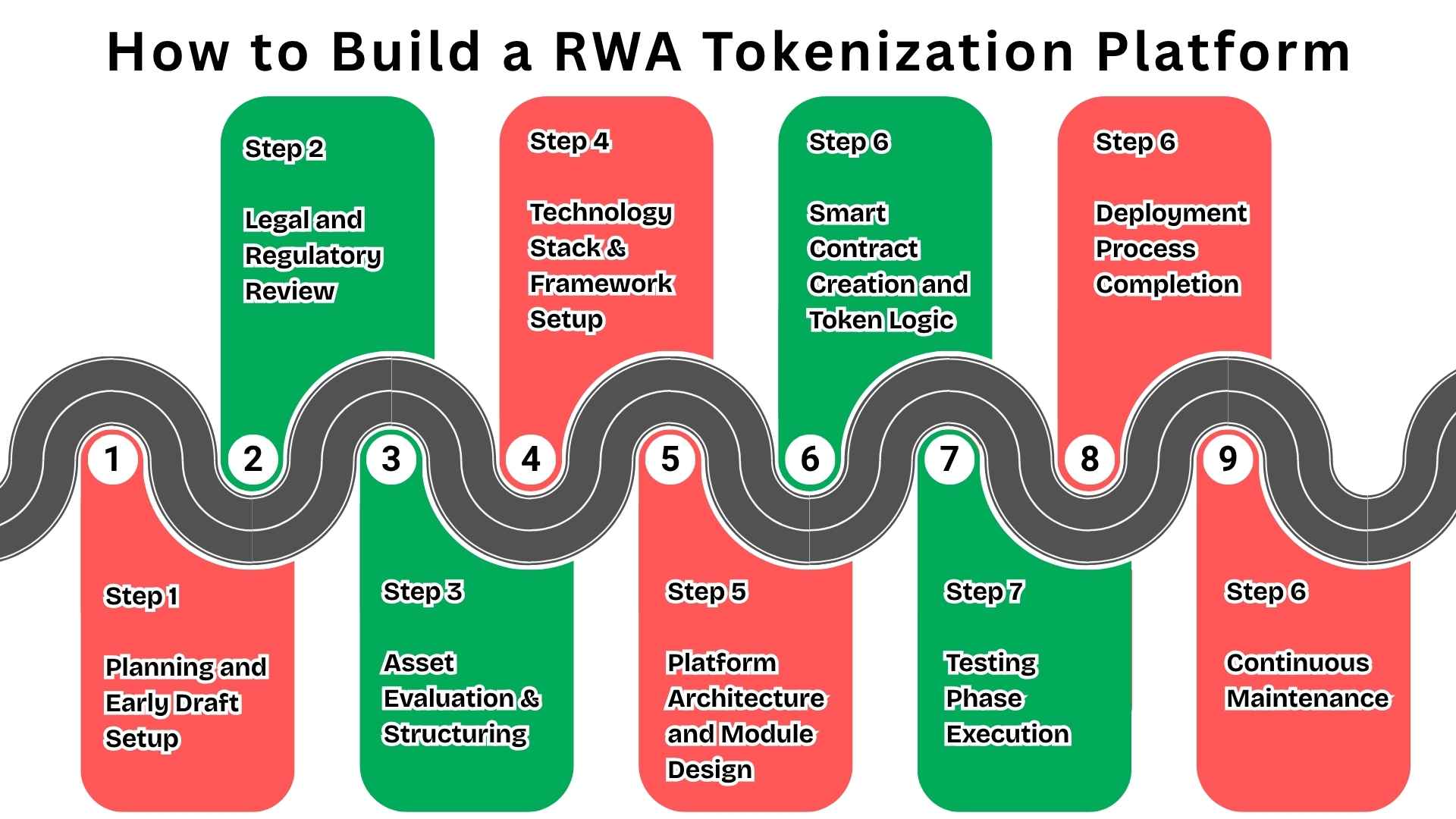
1. Planning and Early Draft Setup
Initial discussions are often with experts, where team members try to explain the overall idea using repetitive comparisons. Estimations begin with clear numbers and move slowly into details that may appear small but carry large future impacts.
Each part of the project requires understanding the time involvement and possible spending needs. Every element must be reviewed to prevent confusion or delay during later work moments that demand technical performance without room for pause.
2. Legal and Regulatory Review
Rule comparisons begin using national-level records before moving into broader international. Official documents are coded that control how asset tokens must behave. Lawyers must stay close during the beginning since the permission lines written on ownership papers connect with how those assets should be turned into tokens.
When regulations shift in the future, the same platform structure must follow without breaking agreements or allowing any illegal handling of values already assigned.
3. Asset Evaluation and Structuring
Land plots and shares inside private firms must go through steps where classification and condition are written clearly, since each detail may later affect token logic. Model decisions must follow asset nature because different categories come with separate technical needs. Land must be measured, and shares must follow company records. This part controls future pricing structure and trading permission steps inside the digital space built around the assets.
4. Technology Stack and Framework Setup
Technical meetings pull developers and planners together where each person brings language preferences, protocol understanding, and platform experience into the conversation. Certain networks may perform faster while others offer contract reliability.
The core goal stays around traffic endurance, where platforms must carry sudden jumps in load without failing at critical moments. Weak foundations during early building stages may cause platform breakage once token movement increases after user flow becomes stronger.
5. Platform Architecture and Module Design
The early layout starts with boxes placed on digital pages that show dashboards, wallets, profile windows, and asset sections. The platform design must support user understanding without confusion. Front-end plans must keep the flow smooth. Each visual step stays mapped with functions that stay tied to contract calls. Design targets comfort but also technical accuracy.
6. Smart Contract Creation and Token Logic
Smart contract setup gets coded where developers assign asset division into pieces by calculating ownership distribution rules that stay fixed unless supply changes later. Ownership actions must have response routes that block illegal steps and allow user recovery if mistakes happen. Scalability functions must not break when user numbers increase. Contracts get tested again and again inside test chains where simulated assets follow rules before the final push to working servers.
7. Testing Phase Execution
Testing teams apply pressure on each section by using loop scripts, manual clicks, and background loads that copy real traffic movements. Errors get solved. Time delays must be measured, and failure points must receive attention. Each module stays under watch to detect memory losses, platform halts, or wallet delays that would affect user experience once the real version becomes active.
8. Deployment Process Completion
The working version gets uploaded to live servers, where real asset tokens stay activated. Platforms go live where users see profiles and contracts working together. The login opens paths into token dashboards and wallet connections. The platform must run without data loss or wrong contract response, as the live environment accepts users with actual asset involvement.
9. Continuous Maintenance
The platform continues to receive review sessions where reports from users are sorted and problems are logged into files that help the technical team understand pattern shifts or repeated delay signals. Response speed must stay inside required limits, and the background database must receive tuning without skipping cycles. Law changes may come without warning and it brings technical corrections.
Why Choose Firebee as Your Real Estate Tokenization Development Company?
- Highly Skilled Team: Our developers, analysts, and advisors work with a deep focus on real estate tokenization. The team carries a good understanding of property structure ownership law, and asset division. Our technical side meets the domain side with full balance to build working platforms with no missing points.
- Safe and Compliant Architecture: Our development team always follows regional asset laws and token sale regulations. We apply correct frameworks that follow all rules so tokens stay legal and valid. Our smart contracts support proper ownership rules with full control under predefined legal actions.
- Cost-Effective Solutions: We develop each project with a strong focus on budget limits and proper value return. Our design and development model avoids waste of time and cost by using tested tools and stable code frameworks. Clients receive full platforms that work without paying extra for complex features.
- Custom Platform Development: We create platforms from scratch using client goals as the central shape of planning. Our design allows real estate projects to tokenize partial or full ownership of land or buildings. Every platform comes with flexible token features suited to project scale and user type.
- Timely Delivery of Projects: We follow set schedules and complete each part of the project within the agreed timeline. Our planning method breaks the work into clear phases where each team handles their duty in fixed time frames. Delays are avoided, and clients receive working platforms as per the planned delivery chart.
Conclusion:
Real estate tokenization offers stable income through fractional ownership and attracts global interest across many asset types. Investors and business owners gain long-term benefits as the process supports transparent records and fast asset transfers. Market demand keeps rising slowly, and token-based platforms now serve as a steady method to raise capital and handle property rights.
Fire Bee Techno Services is a reputed RWA Tokenization Platform Development Company that builds custom tokenization platforms using a strong blockchain structure. Businesses or entrepreneurs planning for digital asset projects can contact our team for proper support. Connect with our experts today to begin your real estate tokenization platform development with assured growth and strong income support.